


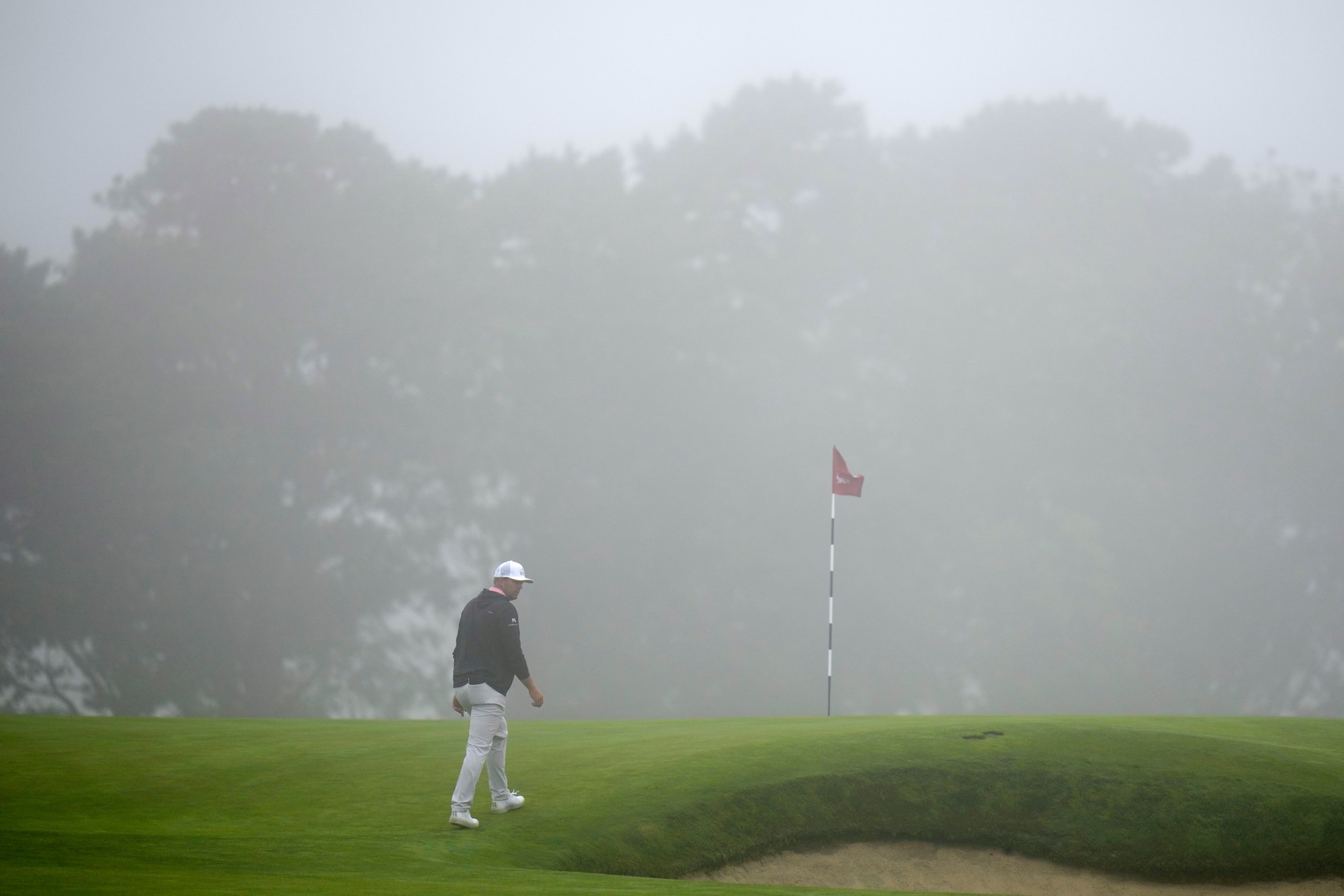
The USGA spent the week preparing for every scenario at the 126th U.S. Open. Thursday threw them a curveball anyway.
Heavy fog suspended play at Shinnecock Hills just 30 minutes into the opening round, with the horn blowing at 7:05 a.m. ET. Players were held in place for 15 minutes while officials waited to see if visibility would improve. It didn’t. The field was brought back into the clubhouse, and play did not resume until 9:05 a.m., pushing all tee times back two hours.
Only 18 of the 156 players in the field had teed off before the stoppage. James Nicholas, the first player off the first tee, told reporters he wasn’t sure he should have started at all. “I just wanted to make sure,” Nicholas said. “I can’t see the fairway.”
Per Golf Channel, the fog was classified as a non-dangerous weather condition. When play resumed, the wind had already begun to pick up.
RELATED: 2026 U.S. Open Preview: Shinnecock Hills Returns as Scheffler Chases the Grand Slam
The delay came on top of an already dramatic week of setup decisions. On Wednesday, USGA Chief Championship Officer John Bodenhamer announced the USGA would slow green speeds to the mid-10s on the Stimpmeter, down from an original target of 11.5 to 12, after new wind models presented late Thursday night showed sustained southwest winds of 12 to 24 mph with gusts exceeding 40 mph through the afternoon. It marks the first time a U.S. Open has been played at green speeds below 11 since Corey Pavin won at Shinnecock in 1995.
The USGA also committed to syringing greens before play and between morning and afternoon waves, with morning tee times moved up roughly 30 minutes to 6:35 a.m. to allow maintenance staff time to apply water between waves. Softer hole locations were also set, with extra caution on the par-3 seventh and par-3 11th holes.
Bodenhamer described syringing as a light misting applied to the putting surface. “Think about it as when you go into the grocery store and you go into the produce department and reach for that head of lettuce and that little mist comes on above and hits your hand,” he said. “That’s all we’re doing to the putting greens. It doesn’t impact playability. It hydrates the leaf blade. When it evaporates, it keeps it cool enough so we don’t lose the friction on the putting greens.”
Rory McIlroy, whose tee time moved from 7:52 a.m. to 9:52 a.m., had already endorsed the approach before the fog arrived. “I really don’t think they need to get much faster,” McIlroy said of the greens earlier in the week. “If they can keep them at that green speed, they can get them firm, and they can use the hole locations that they want to use without having some of the struggles that they have had the last couple of U.S. Opens.”
McIlroy added that conditions at Shinnecock can shift fast. “It’s a golf course where it can turn very quickly,” he said. “You get a day like yesterday with a lot of wind and dry, clear conditions, and I think we’re just going to have to be mindful of that as the week goes on.”
RELATED: USGA, R&A Delay Golf Ball Rollback, Will Explore Alternative Distance Solutions
The USGA’s heightened caution stems directly from two problematic U.S. Opens previously held at Shinnecock. In 2004, the par-3 seventh hole was declared unplayable mid-round after greens dried out to the point where balls could not stay still. In 2018, similar conditions late on Saturday prompted then-USGA CEO Mike Davis to acknowledge the setup had gone too far, after Daniel Berger and Tony Finau shot 66 in the early wave while the final five groups combined to go 67-over.
“My experience… I’ve been doing this for almost 40 years with the USGA the last 16, and I have never seen a place like Shinnecock Hills when you get those drying conditions,” Bodenhamer said. “This place just dries down like nowhere else I’ve ever experienced, and we need to watch it and be very careful.”
Bodenhamer acknowledged the difficulty of making the call. “For a USGA guy my whole life, my dream was always to play in and win the U.S. Open,” he said. “To sit back here and talk about hydrating greens, slowing green speeds, and modifying hole locations, that’s hard to do. But I’ll tell you what, I have great respect for this cathedral of the game and about these great players.”
He said the course will still provide a stiff test. “We could brutalize this place the next few days if we wanted to,” Bodenhamer said. “That’s not what we’re about. We really want it to be fair, and we want it to be what Shinnecock Hills has always been. It will be tough enough. We have pulled every lever that we can to make it fair.”
Scottie Scheffler, pushed from 8:14 a.m. to 10:14 a.m., is chasing the career grand slam this week in his first U.S. Open appearance at Shinnecock. Round 1 is now underway with the full field in play.


