


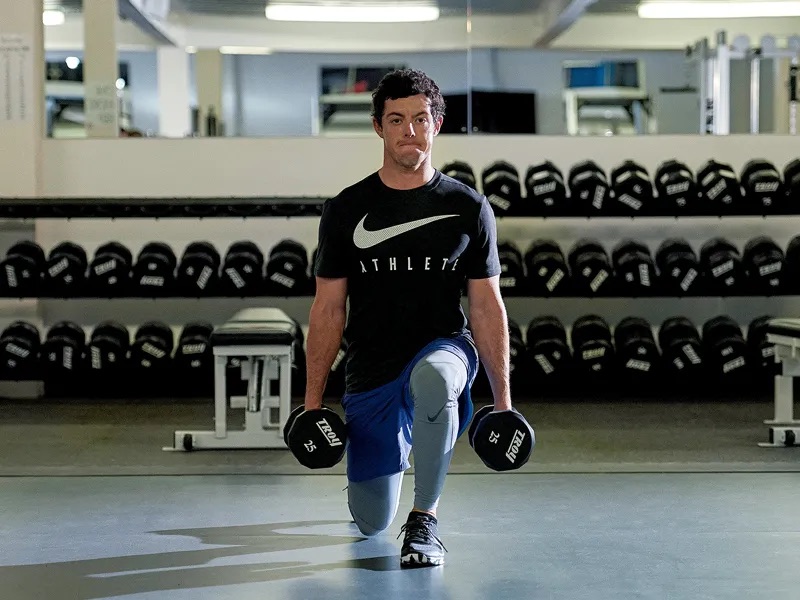
Distance off the tee starts in the gym. Not entirely, and not for everyone, but for most amateur golfers there’s a direct connection between physical fitness and how far the ball goes. The players hitting it 300 yards aren’t just technically sound. They’re strong, explosive, and mobile in ways that translate directly to clubhead speed.
David Sundberg, strength and conditioning coach to PGA Tour players Xander Schauffele and Patrick Cantlay, keeps it simple: “Whether you’re a Tour player or a recreational golfer, the principles are the same. Move well, get strong, and the speed will come.”
Scott Shepard, one of the top golf performance coaches in the country, adds an important caveat: “The idea that you should just swing as hard as you can and throw out all technique is, in my opinion, one of the most dangerous ideas in modern speed instruction. Golf is all about having efficiency and consistency, so you want to make sure that golfers chasing speed will not end up hurting their mechanics.”
That starts with building the right foundation. Here are five exercises that will make a real difference.
Power in the golf swing starts from the ground up. Every extra yard you gain starts with how well you can load and push off the ground. The squat builds exactly that. Strong legs and glutes give you a stable base to rotate from, and the more force you can generate from the ground, the more speed gets transferred up through the hips, torso, and arms to the clubhead.
Jason Day, a former world number one and one of the longest hitters of his generation, has been outspoken about the role of lower body strength in his game. “For golf, you can’t have a big upper body and a small lower one. You’ve got to have big strong legs and a strong core. I do a lot of squats, do a lot of trap-bar deadlifts, and a lot of sumo deadlifts.”
You don’t need to be squatting your bodyweight to see results. Start with goblet squats or bodyweight squats to build the pattern, then gradually add load. Three sets of 8 to 10 reps, two to three times a week is plenty.
The hip hinge is the foundation of the golf swing. At address, you’re in a hip hinge. At the top of the backswing, you’re loading into a hip hinge. At impact, you’re firing out of one. If you can’t hinge properly, you’re losing power before the swing even starts.
Deadlifts train the hip hinge pattern under load. They build posterior chain strength, the hamstrings, glutes, and lower back, and they teach your body to load and fire in the same sequence the golf swing demands. Start with a Romanian deadlift if conventional deadlifts feel uncomfortable.
If squats and deadlifts build the engine, medicine ball throws teach it how to fire in a golf-specific pattern. The rotational throw replicates the exact movement of the downswing, loading into the trail side and exploding through to the lead side.
Scott Shepard describes plyometric exercises like these as essential for translating gym strength into swing speed. “Plyometrics are simply any form of explosive exercise training. They follow a simple order: to create a stretch or lengthening in a muscle or group of muscles that you are about to contract during a movement. Creating a stretch can aid in the speed and intensity of muscle firing, producing faster and more powerful movements.”
Stand sideways to a wall, load into your trail hip, and throw the ball explosively into the wall with a full rotation. Three sets of 8 to 10 throws per side.
RELATED: How to Add Distance to Your Driver (Without Swinging Harder)
Rotational resistance training builds the core strength that holds your swing together under speed. A cable machine or resistance band anchored at hip height lets you train the exact rotation pattern of the golf swing with load.
Stand perpendicular to the anchor point, set up in your golf posture, and rotate through from trail side to lead side against the resistance. Do both directions. Rotating away from the anchor replicates the backswing load; rotating toward it replicates the through swing.
Explosive lower body training develops rate of force development, which is how quickly your muscles can fire. That’s different from raw strength. A golfer who can squat 300 pounds but can’t generate force quickly won’t transfer that strength to clubhead speed. Lateral bounds, broad jumps, and single-leg hops train the fast-twitch muscle fibers that produce explosive speed.
Tyler Campbell, director of performance at the Golf Performance Center in Ridgefield, Connecticut, recommends explosive lower body work specifically for golfers looking to increase clubhead speed. His 90-degree broad jump drill fires the hips and develops the rotational speed that translates directly to more distance off the tee.
Start with bodyweight lateral bounds, jumping laterally and landing softly on one foot. Three sets of 6 to 8 reps per side.
None of these exercises will add distance overnight. Sundberg puts the priority in the right order: “The first thing we always want to do is keep players injury-free. Once they’re healthy and moving well, that’s when we can start adding the performance stuff.”
Build the foundation first. Most golfers who commit to speed and strength training can add around 5 mph of average clubhead speed within three months, which translates to roughly 12 to 15 yards of carry. Two to three sessions per week, focused on these five movements, is enough.


